

“The stiff section”—that’s what my professor called the Prophets of the Old Testament. It’s the part of the Bible so rarely perused, whether in private or over pulpits, that it stays as stiff as the day it was printed and plastic-wrapped. But who are we kidding? It ain’t just the Prophets. Much of the OT, I’ve discovered, stays plastic-stiff and unread by otherwise devoted Christians sitting in church every Sunday, who prefer to leave the Scripture reading to the pastor. For a people meant to be founded on the Word of God, the Bible often sits on the shelf like it has a warning label: “Do not handle—professionals only.” After a deep dive into the Hebrew Bible (the OT) this year, I agree that parts of it can seem opaque without a little help. But I can also affirm that once you learn the literary and historical context, a richness unfolds in these ancient pages that illuminates the Gospels and all of modern life. The Old Testament is the bestament! So come with me, and let’s crack open that plastic wrap.

People travel differently. Some like setting off on a solo adventure, using apps and advice to find their way on the fly. Me, I prefer to tuck into a backseat while someone who knows the terrain carries me along like the coddled dogs I see at the airport. Thus, when my friends invited me to jump on to their fourth trip to Italy, I jumped on, and fast. However, knowing I had visited Europe several times but not yet Italy, they hesitated. “We don’t know what you’ll want to see,” they said, “but our friends are joining and we were already planning to take them to our favorite spots. We kind of have it all mapped out.”
I nodded. “You promise?”

Before seminary, I might have heard the word “exegesis” across a pulpit here and there and figured it was a super technical theology term. Exa-Jesus. Or something. Who would’ve thought, after all these years, I’d be training in exegesis and learning to spell it, too! This deep dive into the Biblical text is precise and demanding and fascinating. “Exegesis,” it turns out, is a Greek word meaning “to lead out”—as in, the “leading out” of Scripture’s meaning and application for the church. In class, we study how to consider the original language of a passage, as well as the surrounding historical context and the wider Scriptural context of redemptive history—meaning, where does this episode fit within God’s long-game plan of redemption? We start by evaluating the author’s purpose in writing this particular history to his original audience, and then, because it is God’s inspired word to every age, we attempt to faithfully apply it to the church today. We also consult well-informed commentaries from faithful scholars that help lend insight to the passage; and in this way, iron sharpens iron and the church continues to build itself up in the faith and kick this (formidable) can down the road. (And if you wonder why in the world this kind of meticulous scholarly study of Scripture even matters, as I used to, join me in my own lightbulb moment of realizing, who did I think researched and wrote all those illuminating historical, archaeological, and theological footnotes in my Study Bible all this time? A thousand monkeys at a thousand typewriters?)

It is remarkable how little we think about the end when the end comes, without fail, to us all. In studying a bit of philosophy, I am reminded how consuming has been man’s search for truth, how chronic his pounding questions: what is man? What is good? What is our ultimate end? Lately, we seem brilliant at ignoring these questions in the noise and nonsense of our times, but they’re not ignoring us. The nihilism, atheism, pragmatism and materialism of former philosophers still smog up the air we breathe today; and I daresay the story they whisper is wrong. I’m now two years into rigorous seminary study, and I am astounded by the ever-unfolding fitness of the Biblical narrative, how fully it speaks to the true end of man—both his telos, Greek for “goal” or “purpose,” and his hard-stop end at a headstone. Present culture, stumbling atop faulty premises, is proving inadequate for life in a larger story; and I believe man today is sick unto death because his ends are off.


Let me get geeky with Greeky.
It’s strange, the one class I tried to get out of ended up being my favorite course in my first year of seminary. I relish the New Testament like any card-carrying Christian, but I was never attracted to its original Greek manuscript. I don’t know if you “feel” a language like I do, but I find I’m initially attracted to some and not others. The blocky, bendy Hebrew letters on traffic signs in Israel called to me, but the swordlike slashes and dots of the Arabic font directly beneath left me cold. I had been drawn to French sounds and French food in my youth, but I was unimpressed by the Greek letters that kept inserting themselves into math books and college sweatshirts. Math and frats did not speak to me. I sort of tried. I was dragged to one frat party my first week of college and found it so awkward that I pretended to fall asleep on the couch just for an excuse to go back to my dorm room. One week into my adult life, and it was clear the only Greek pledge I’d ever make would be my undying commitment to gyros.

One sweltering night, before Covid and culture wars sent us indoors, I found a meetup group online that met downtown to discuss tough topics. I had time to join just once before jetting off to L’Abri to discuss tough topics—but I picked a good crowd, and a good night. (These thinkers meet in a dim chamber in a lush little Prohibition-era tavern. For two hours in the smoke and low lighting, I was fully convinced that I could be the next great American novelist, if only I could locate a cigar and a talent for nihilistic fiction.) On tap that night was a lively debate on Socialism. The cozy room was packed with people of all politics and races, students and business owners, marrieds and singles, atheists and me; yet despite the diversity, I noted that well over half the room heartily approved moving toward socialism in America. In the crossfire, I caught snippets like, “Norway!” “Scandinavia.” “Single payer healthcare!”—and then the fist-pounding rebuttals: “Look at Venezuela!” and “It has never worked ANYWHERE.” I nodded and took mental notes, but I prayed they wouldn’t call on me. I’m no dummy, but before that night, I sort of thought “socialism” was what I needed to work on to get popular in middle school.

Believing in God in a secular age can feel like having a split personality—or, not so much a schism in yourself, but a straining to live in two worlds at once, with two clashing sets of codes and commands. Or maybe it’s like being married—I mean, you talk to this person every day, you’ve cried and changed and your friends know all the details!—but as soon as you leave the house to apply for a loan or library card, they put down “married” in quotes and trade pitying whispers in the back room. “Shame, these retrogrades. Think there’s someone there. It could be dangerous to keep playing along.”
“Shhh. It makes them happy. As long as they keep it to themselves!”
The conflict between the two worlds can get wearing. People pleasing might have been your jam, had not your regressive views proved to be so unpleasant. It’s simple enough to see why—the matter has long been settled, and the spirit of the age has drawn a line in the sand: the modern, rational man can no longer suffer the foolish specter of religious faith.
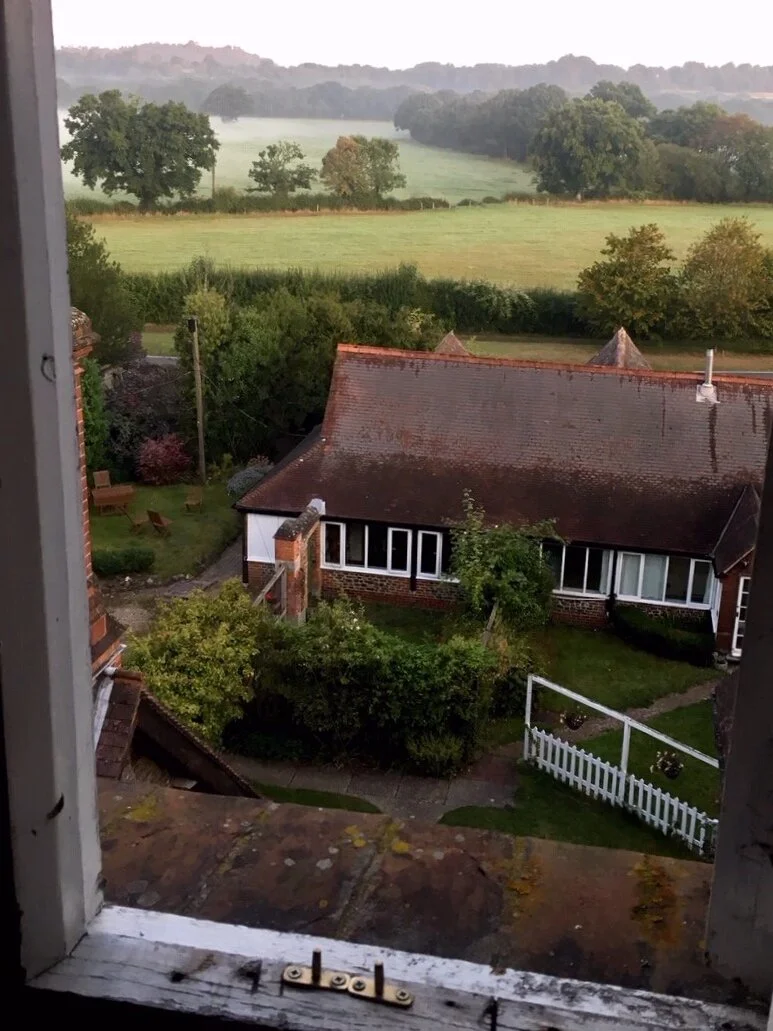
I walked home from the local pub last night, musing on how I’ve lived half of the year in this quiet English village. It was the kind of cold, late autumn drizzle that slips in as the year wanes, weather you button up against but almost welcome in its gentleness. I drifted noiselessly past cozy houses with windows glowing warmly in the darkness, houses so near the sidewalk that, with a few steps, I could touch the winding roses on the walls if I wanted to. I thought of the way small distances have defined this season at L’Abri. There’s a short walk to the pub on a night off, a small radius of regular steps within the huge Manor House where we do our chores and community life, and almost no space between the journeyers who have paused for a time on this small patch of English countryside to share our lives. Eating, working, discussing, heck, even sleeping stuffed together into dorm rooms! I strain to recall the vast, vacuous space I left back in the States, where life is spread out and the miles are covered in cars, where one commutes for community, for friendship, for family, for everything, yet the journey so often is taken alone.

What’s it like when you’ve lived alone for years, and you suddenly move into creaky old English manor house with 30 other people—dorming in bunk beds like you’re back at Summer Camp, forced to think deeply and discuss daily, and spending half your day cleaning bathrooms, cooking, or doing laundry for the entire house?
In a word, fantastic.

I had been thinking a lot about Hitler. It wasn’t my habit to ruminate on ruthless tyrants, but to be fair, I suddenly had plenty of time on my hands.
It’s hard to say where I’ve been for the past three months. Let me clarify that. I’ve physically gone no farther than the few steps between my couch and my front door—and that while hobbling on crutches. Yes, after my grand tidying marathon, let the reader remember, I had concluded that I’d made room for my next step. The very morning I was carrying down the last box of tidy giveaways for Goodwill, I tripped off my stairs and fractured my foot. (Should’ve been more specific about that “next step.”)

If you find your life is stuck in a rut, would you consider the remedy might be to…<ahem>…tidy your house? I might have dismissed the premise of The Life-Changing Magic of Tidying Up myself, had I not been adrift in my own particular doldrums. I leafed through the small and elegant book; its proposal was not exactly modest. Japanese tidying guru, Marie Kondo, claims that her clients (now on a three-month waiting list) not only learn to beat back bulging closets, but unleash untold vivacity and vision in the process. “In this book,” she declares, “I have summed up how to put your space in order in a way that will change your life forever.” (p1)
I could use such a change. My job had recently come to an end, as had a dating relationship; and now that I was slowly sliding into middle age, I was growing rather weary of the “seasons of life” thing. Starting again was not something I wanted at an age when, let’s face it, I’d hoped certain things would be settled by now. But no—it was back to the drawing board. This time, however, I didn’t want to draw up the same old plans with the same old pencils. I needed new tools; I wanted fresh eyes.

I’ve been blindsided. I’ve discovered your brain can do something mine can’t…and I didn’t see it coming. I—the writer!—who weaves words so evocatively for you, dear reader, am floored to find that most of you, in fact…
see these images in your minds.
Well, duh, you say—don’t we all? No. We don’t. And I had no idea. We’ve been sharing the same vocabulary all this time—“mind’s eye,” “mental image,” “picture this”—but I’ve assumed from playground days that we were speaking in a figurative, metaphorical way. Nope. Turns out your noggin actually spins images in living color, while I am essentially blind in the mind. On the visualizing spectrum, I land on an extreme called aphantasia—“without fantasy.” It’s a thing, I have it, and discovering you don’t has blown my blind mind.
* * *

I feel guilty, really. Why do I get to travel to spectacular places when I only leave stupider than before? Alright, take it easy. But here’s the facts: I had the opportunity to live in Jerusalem for six months right out of college, working at a youth/media ministry, and I still didn’t absorb anything about the history and culture. That was after already having toured Israel earlier that year, then returning to Jerusalem to live and work. Twelve years later, I still hadn’t quite pieced together which parts of the Bible went where. I wanted to start all over as a tourist. This April, my church took a 10-day tour of Israel, and I hopped on for trip #3. Three times to Israel, when many folks would jump at the chance to go just once, and could probably recite the history backwards on returning. Oh well, those folks can probably sing like Mariah Carey and I can’t, so we’re even.

What can a perfect man have to learn? He don’t need no education! And why should a sinless Savior have to suffer? Pain means punishment, right? If there’s punishment to be had, it should fall to a world drowning in its sin; and if there’s a savior to be had from an over-generous heaven, we might well expect a Deus ex machina to drop fresh from the sky, ready to save the day. After all, if one is drowning, one does not expect his rescuer to jump in and take time learning to swim. Sweating, suffering, growing into his skin and trudging through the tedium of 24 hours, same as us—this is not what we expected from our Messiah. No legend of the gods ever quite anticipated it. But this is no airy legend; this is mundane stuff. Scripture teaches that no man avoids the hours-long days of learning God’s ways. Not even a Savior.

Disclaimer: Although this purports to be a “sports” entry, author does not know sports. However, she loves competition—she tries to swing for the fences (a phrase she uses liberally and marginally understands). Please grant her creative license, and bear in mind that playing with words could also be considered a sport. To understand the exact extent of author’s sports knowledge, please watch this video with SNL actor Kyle Mooney.[1]
In a recent Sunday sermon, Pastor Ryan related the parable of the persistent widow’s grit to a boxing technique of “wearing someone out.” I perked up immediately—not because I love boxing, but because I recognized the tactic. Worn down by an opponent, pummeled relentlessly until you struggle to see through the swelling? Been there, boxed that, got the scars to prove it. I’ve eaten my share of life’s peach clobbering. These battles, cliché though it be, made me stronger; I learned not only how to take a punch, but how to pack my own. Sometimes relentless opposition awakens a relentless fighter.

“In your light, we see light.” Ps 36.9
Light is delightful. The loveliest things on earth are light-givers—glittering seas, fiery jewels with light-reflecting facets, the midsummer shimmer of sunshine, the glowing moon and sparkling stars, the numinous luminescence of the northern lights, even fireflies flashing dots of night light from their heinies! Some of my favorite words describe light: sparkle, glitter, shimmer, glimmer, glint, brilliant, dazzle. When we feel happy, we express it with light: a “sunny” mood, a radiant outlook, our faces shine. When we’re depressed, we call it gloom, “darkness.” When darkness persists, in the skies or in our souls, we ache for light. Who doesn’t love light?
We don’t. We don’t love the light.


I’m having one of those unedited days. It’s dragging. I swear these listless hours are just a bunch of raw footage that’s going to end up on the cutting room floor. So why do I have to live it? What’s the point?

It's that time of year! Time to pull down the ol' musty box of Christmas standards, run 'em through shiny new auto-tune, and put them on the radio for the next generation to poke their eyes out to. And I'm right there every year, bopping along, singing songs, thinking thoughts in my private Christmas head. Ah, but this year. This year I have a blog.

It was charged as “the artistic crime of the century,” and it was the first time I considered becoming a criminal. I watched Man on Wire, a documentary about Philippe Petit, the tightrope walker who secretly strung a high wire between the Twin Towers in 1974. The artist in me was utterly taken by this tale of a criminal break-in for the purpose of effecting a grand, artistic feat. He would be French, too, freaking French people!—this art-for-its-own-sake snobbery and sensuality, this enchanting and exasperating high-mindedness, this impracticality I frown upon and secretly embrace with all my quixotic heart.

They say talk is cheap, but it’s not: it’s free. Been amusing myself with this idea—what if you had to pay for every word you said or typed? And you had to budget for it and pre-pay, like, “They cut my hours at work this week; looks like I’ll be the quiet one at the party this weekend.” Or “Christmas bonus! Now I can finally afford to have “The Talk” with Junior.” If you went off on an unplanned rant, you’d get billed for it the next day, plus an overage fee. It’s fun to think about: if we had to drop coin for "free speech," what would each of us still pay to say?

This book cracked my heart open. Like tripping onto a back-alley scene I couldn’t un-see, it haunted me. But to be fair, I went out late at night looking for it.

Earlier this year, I got to travel with a team from my church to visit our church plant in Colombia. Many of you may not have seen the story when I posted it on Facebook, so I'm publishing it here on my blog so it will exist for all time (or until I forget to pay my website hosting fees and it disappears for all time. Either way, we're talking in terms of eternity).


I like to read layman’s books on science and pretend I understand them. Black holes, quantum physics—I can’t quit perusing the Science shelf at my library. But no matter the marathon of study, I swear I retain only a tidbit of trivia from each tome. I’m considering moving down to children’s books—although I did read one about Space, and all I recall is that the first dog the Russians rocketed into space died of a heart attack from abject terror, or something terrible and totally brain-sticking like that. Yes, I enjoy reading about science and Schrödinger’s cat. No, I don’t really grasp it. Can’t be brilliant at everything. Wouldn’t be fair.

Humans be hung up on each other’s conduct. Hop on the Web, drop by the watercooler: here’s a herd of humans, spouting sharp views on who’s acting right and who’s losing. But what’s our standard of “right?” And who ultimately decides who’s “in” and who’s “out?” Human opinion is fickle and restless; it will change next month, but we still like to play along. And as standards continue to shift and bend, it’s also habit to bemoan “what the world is coming to.” But that’s a pointless exercise; even the Bible says it’s foolish to yearn for the good ol’ days. They don’t exist. Humans were never better or worse than they are right now.